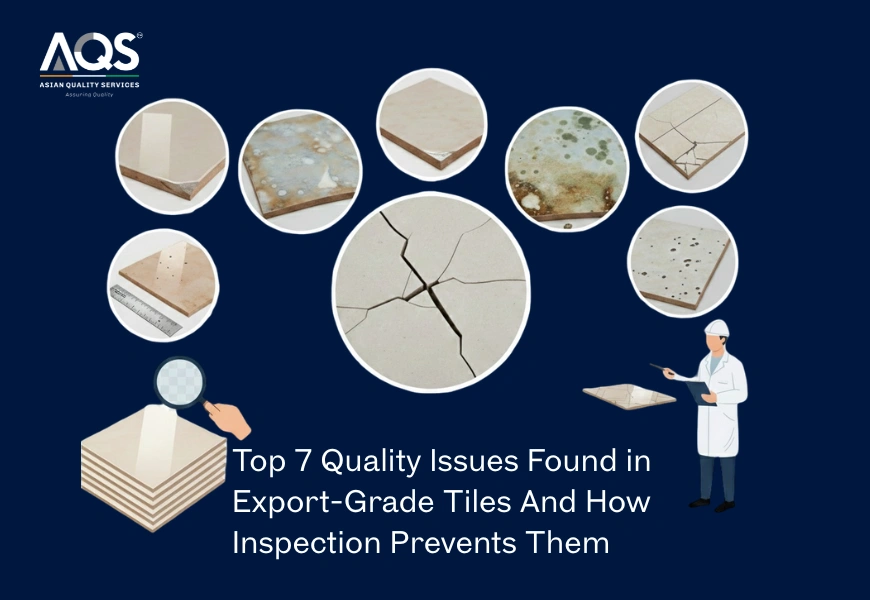
The most common quality issues in export-grade tiles include color mismatch, size variation, surface defects, warpage, high water absorption, low strength, and packaging errors. Third party tile inspection in India helps prevent these issues through sampling, testing, and pre-shipment verification.
This is why structured tiles quality control by a third party tile inspection company in India is essential for the importers. From production monitoring to the final shipment checks, inspection plays a critical role in protecting buyers from all the costly surprises.
Where Export Tile Shipments Commonly Go Wrong
Before tiles are approved for shipment, it’s important to understand where quality problems usually occur. The following are the most common quality issues found in export tiles and how proper inspection helps prevent them.
1. Why Colour Mismatch Is One of the Costliest Export Mistakes?
Color consistency is one of the most common challenges in tile exports. Even a slight variation in glaze tone or firing temperature can create visible shade differences between cartons.
For large projects, this becomes a serious issue. Contractors expect uniformity across floors and walls. When batches differ, entire areas may need replacement.
A proper ceramic tile inspection includes random carton sampling and side-by-side comparison under natural and artificial light. Inspectors verify shade codes and ensure batch segregation before shipment. Early detection prevents mixed shades from reaching the buyer.
2. How Small Dimensional Errors Turn Into Big Installation Problems
A dimensional accuracy is critical for smooth installation. With small differences in certain tile size or thickness often result in uneven grout lines and alignment problems.
These issues often arise due to calibration errors or inconsistent pressing during production. Without structured tiles qc in India, variations may go unnoticed until tiles are laid on-site.
The tiles quality control teams measure the tile length, width, thickness, and edge straightness using calibrated tools. By checking tolerance levels during production and pre-shipment, inspectors confirm compliance with buyer specifications.
3. The Hidden Surface Flaws That Buyers Notice First
With surface problems such as pinholes, cracks, glaze bubbles, black spots, and scratches, one thing is that they have the potential to significantly reduce product value. Some defects are minor but visible under light; others weaken the tile surface.
A professional porcelain tile quality check includes a detailed visual examination of randomly selected tiles from different pallets. Inspectors assess gloss level, surface smoothness, and structural integrity to ensure export-grade appearance.
Catching these defects before shipment prevents complaints from retailers and end customers.
4. When Tiles Refuse to Sit Flat, And Why It Matters
Tiles that are not perfectly flat create installation challenges. Warped tiles may rock on flat surfaces or leave uneven edges once installed.
Flatness issues usually result from improper firing temperatures or cooling processes. These defects may not be visible in small samples but become noticeable during bulk production.
Tile Inspector uses straight edges and flat surface testing methods to evaluate tile warpage. Identifying this issue during tile quality control prevents large-scale installation problems at the destination.
5. What Absorption Levels Reveal About Tile Durability
Water absorption levels determine where a tile can be used. Porcelain tiles must meet low absorption standards to qualify for certain applications.
If factories fail to maintain firing standards, absorption rates may increase, reducing durability. For buyers in humid or wet climates, this can cause long-term damage.
A structured porcelain tile quality check includes absorption testing and validation against agreed specifications. This ensures that exported tiles meet performance expectations and international standards.
6. Strength Failures That Don’t Show Until It’s Too Late
Export-grade tiles must withstand transport, installation, and long-term use. Weak tiles may crack under pressure or during handling.
Breaking strength is affected by raw material composition and production tile quality controls. Without independent verification, buyers may receive structurally compromised tiles.
A reliable tile inspection agency in India conducts strength tests and reviews factory testing records. Independent checks confirm that tiles meet durability requirements before shipment.
Companies like AQS support importers by combining on-site factory inspections with structured reporting, ensuring that performance standards are verified before containers leave the facility.
7. The Final Shipment Mistakes That Cause the Most Disputes
Even the high-quality tiles can be damaged due to weak cartons or improper pallet stacking. The mixed cartons, wrong labels, and incomplete documentation are some of the factors that also lead to customs delays.
Many shipment disputes usually arise not from product defects but from packaging errors. A complete ceramic tile inspection includes carton strength checks, pallet arrangement review, and verification of labeling accuracy.
Inspectors confirm that:
- Cartons match purchase order quantities
- Shade and size labels are correct
- Pallets are securely strapped
- Containers are properly loaded
This final step reduces breakage in transit and prevents rejection at destination ports.
Conclusion

Tiles for export must have high quality in terms of appearance, strength, and consistency. The most common problems that can cause disputes if not corrected are variations in shade, dimensional problems, surface defects, warpage, excessive water absorption, low breaking strength, and/or inadequate packing methods.
Professional inspections can help you eliminate these potential problems before your tiles reach their destination market. AQS is an experienced independent third party tile inspection company in India that conducts ceramic tile inspection and porcelain tile inspection in India.
By utilizing AQS’s inspection services, the best tiles qc in India prior to shipping, importers can rest assured that they will be supplying their customers with consistent, high-quality tiles worldwide.